I was watching John Romer's Byzantium, The lost Empire and when he describes the famous
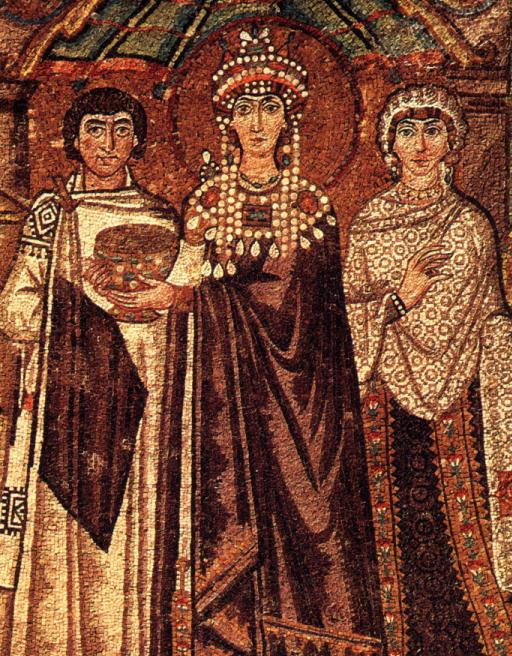
San Vitale mosaics with Theodora and her court he says that
2 - 3 months after the mosaic was finished, Theodora died of cancer. That was something I did not know. I decided to verify. My 1st source is from
about.com and the 2nd from
http://employees.oneonta.edu/farberas/arth/arth212/san_vitale.html. I have chosen to copy the texts, because in it you will read a lot more interesting facts. In the 1st text, you will read that she played a VITAL role in governing the state, she contributed in laws favouring the rights of women and generally provided a lot of support to her husband Justinian. As I had mentioned in
a previous post about Theodora, we owe a lot to this woman, dancer, perhaps former courtesan and definitely of humble origins.
quote
Possibly the most powerful woman in Byzantine history, Theodora was the wife of one of the most significant emperors of the Eastern Roman Empire, Justinian I.
Born the daughter of a bearkeeper, Theodora began her career as an actress at an early age. She may also have been a courtesan, and she gave birth to at least one child out of wedlock. Converting to monophysitism, Theodora became a devout, if unorthodox, Christian, and for a time earned a living as a wool spinner.
Theodora impressed Justinian, nephew of the current emperor Justin I, with her beauty, wit and insight, and he made her his mistress and raised her to the rank of patrician. In 525 they were wed, and when Justinian ascended to the throne two years later, Theodora was proclaimed "augusta."
The empress exercised notable influence on her husband and on the workings of state. In addition to providing support and encouragement to Justinian, Theodora took part in making laws of the period (nearly all of which mention her name) and handled diplomatic functions ordinarily reserved for the emperor. She is famous for advising her husband to stand his ground during the Nika revolt, which he did successfully.
Theodora is well-known for sponsoring laws affecting women's rights in divorce, inheritance and guardianship, and prostitution; in particular, she saw to it that strict laws were passed preventing traffic in young girls. She also worked to mitigate laws against the monophysites, successfully ending their persecution, though never convincing Justinian to alter the official policy that favored Orthodoxy.
It is very difficult to gauge what achievements of Justinian's reign are owed to Empress Theodora, for the two worked together closely, and after her death Justinian showed a considerable decrease in activity. Theodora died at about age 50, probably from cancer.
unquote
The following text from oneonta helps us understand that
1. San Vitale church was dedicated to Bishop Maximian who was appointed Bishop in 546. He is actually the only labeled figure in the Justinian mosaic.
It is very logical that the mosaics would have taken (at least) 2 years to finish between Bishop Maximian's appointment and Theodora's death.
quote
St. Vitalis, a second century martyr, was believed to be the head of a family of martyrs who were associated with the local foundation of Christianity. St. Vitalis was believed to be the husband of St. Valeria and the father of Sts. Gervase and Prothase. According to the story of Gervase and Prothase, they along with St. Vitalis were martyred on the spot of a "little Colosseum," the site of the church of San Vitale. As effectively the "proto" or first martyr of Ravenna, St. Vitalis was seen as the spiritual head of the Christian community in Ravenna.
The Church was begun by the Orthodox bishop of Ravenna, Ecclesius (522-32), shortly after the death of Theodoric in 526. The church was apparently financed by Julius Argentarius, whose name suggests he was a banker. Several capitals bear the monogram of Bishop Victor (538-545). The Church was dedicated by Bishop Maximian (546-56) in 547. The apse mosaic shows on the left hand side St. Vitalis receiving the crown of martyrdom from the enthroned Christ, while on the right hand side of the same mosaic Ecclesius is shown presenting a model of the church. Bishop Maximian appears as the only labeled figure in the Justinian mosaic.
Since Maximian was appointed as bishop of Ravenna in 546, this suggests
that the mosaic must be from after that date.