The mosaic artist has to consider the many facets of mosaic art which differentiate it from painting.
If I was to split mosaic making into phases I would say that the
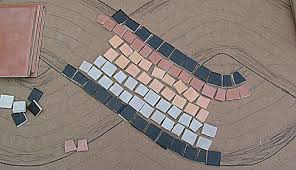
1st phase is the designing and defining process on what to make, how, which materials to use, the amount of mosaic tiles you will approximately need, what type of surface you will use, what technique best suits and accommodates your design-hope I have not left anything).
The
2nd phase is cutting your material. It can be stone, glass, marble. What I wanted to discuss today was SPACE which would belong to the
3rd phase, the making process.
Space is the soul of mosaic. The materials used for mosaic making are cut, and therefore, what you construct is in a way made with fragments and your end result is fragmentary. If you want to make mosaic portraits or objects or murals you may not want to ignore and defy this feature, whereas if you are covering a floor, a table, a wall, surfaces that need to be even, the space between the pieces is usually kept to a minimum for specific practical reasons. The main concern when making mosaic to cover surfaces is practicality and durability. Aesthetics are vital but co-exist with the practicality with the work.
The fragmentary character of mosaic lifts the work into another level. The one I call
metaphysical, immaterial. How can we have materials that are immaterial? Art made with materials (versus art made with words, like literature) that invites you into a non material context?
The interstice (space) acts as an "opponent" to the real world which has no spaces. To understand this, compare the landscape, nature, the world: it has continuity.
Mosaic "breaks" continuity because it does not "copy" landscapes, nature, images of the world the way they are.
Mosaic represents reality using a "fragmentary" technique. No misleading here. I do not make a picture and then break it into pieces. I create a picture with pieces. I create another reality, a new reality which 1) resembles reality 2) reproduces reality 3) breaks reality.
Enough with philosophy now. Let me post some pictures where you can see the function of SPACE.
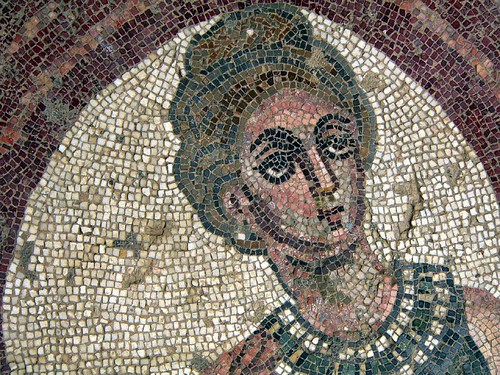
In the first picture you see a portrait from Pompei. Wonderful right? A masterpiece. Notice that
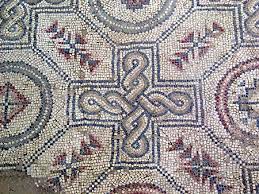
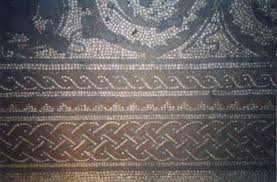
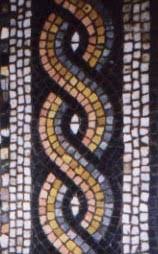
the interstices have been kept to a minimum. However, you can still tell it's a mosaic. In the 2nd picture the spaces between the mosaics are a bit more evident. The mosaic here is from a floor. Let's see now a mosaic with large spaces between the pieces.
Doesn't it feel more "mosaic" than the portrait from Pompeii?
Doesn't it "represent" a figure instead of illustrating, demostrating it?
Isn't the St.Ambrose mosaic more mesmerising and more intriguing? (Mosaic art has allowed the flourishing of religious mosaics due to this fragmentary/symbolical/metaphysical character).
Why imitate painting if mosaic can be so rich and complete in its own right?
Fragmentary yet complete.
I hope you enjoyed the post.
Back soon.
Copying or distributing the above content should include mentioning the source. Thank you.