This is to announce that I will not be blogging for a while. I may even stop blogging definitely. At least from Mosaicology. The reasons are plenty. First, I want to focus on my family and my work as a translator. Second, keeping this blog leads me nowhere especially as a mosaic artist since my life choices impede me from making any artistic work at the moment. I no longer believe in substitutes. This blog was a substitute and sadly it took me a while to realise that. I may be back but not in the form of what Mosaicology has been. Something new.
Those that follow me on Twitter will be advised of a new twitter account if I decide to create one (I think I might cause I love Twitter).
To stay in touch or if you are interested in my translation services (including anything related to mosaics) email me at magdamosaico@gmail.com
Monday, January 16, 2012


Friday, January 13, 2012
The magnificent pebble mosaics on Chalki island in Greece and the island's connection to Tarpon Springs in Florida, USA !!!?


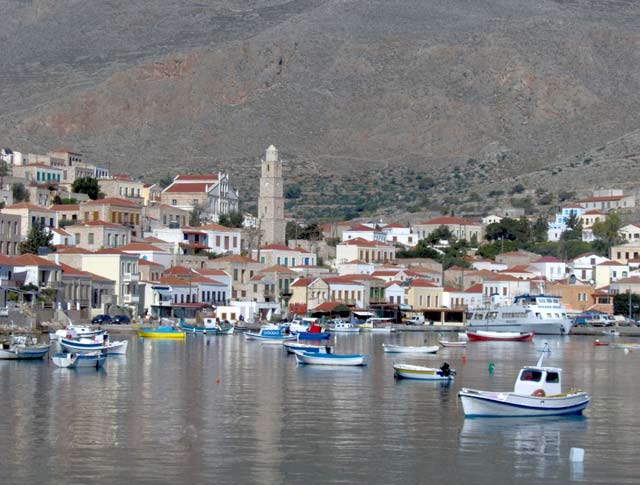

How is it possible that you "stumble upon" an island?
This is what happened to me while researching about Kastelorizo, the "limestone" island. Chalki is close to Kastelorizo, belonging to the Dodecanese group of Greek islands.
On Chalki island you can admire some of the world's finest pebble mosaics. Unfortunately the few images I found on internet have copyright but if you go to this gallery HERE on Flickr you will see what I mean.
Now, what's more about this little island ? Many of its inhabitants have immigrated to Florida and established a sponge fishing business there!
Chalki (Halki) Island lies 16 km from Rhodes and 302 nautical miles from Piraeus. One of Greece's smallest islands it has 28 sq. km of land mass and 34 km of coastline. It has a population of under 300. No cars are allowed on the island. The capital and port of Nimborio is built ampitheatrically on the SE side of the island and on the Bay of Nimborio. Many of the inhabitants have immigrated to Tarpon Springs, Florida and established a sponge fishing enterprise there. Thats why the road from the main town and port is called Tarpon Springs Blvd., in honor of the immigrants who financed its construction. Beaches on both the north and south coasts are reached from the capital on foot or by caique of which Kania, Areta, Giali and Trachia are the nicest. 15 minutes walk along the 'blvd.' brings you to sandy Pondamos Beach with its taverna and umbrellas. Nimborio's Church of St. Nicolas with its important wall paintings and magnificent pebble mosais courtyard is the island's main attraction. The former capital Hora was inland to escape marauding pirates and is now deserted. In its heyday there were some 4000 residents. The ruined medeival castle was built on the site of the ancient acropolis. There are 3 monasteries on the island: Taxiarch Michael of St. John, Holy Trinity and Holy Cross.
More spectacular pebble mosaics from Chalki HERE
Quoted text from holiday-in-athens
Read more about Tarpon Springs HERE
Images link to their source
Wednesday, January 11, 2012
Romera Mosaic Vegetable Dish
 |
| image credit Katy McLaughlin |

Read more about chef and neurologist Romera HERE and HERE. Romera restaurant website HERE
Wednesday, January 4, 2012
Chi è la più bella del reame? (Who's the most beautiful of all?)

This is not the first time I feature a mosaic mirror on Mosaicology. Mosaic mirrors are a particular case as they combine small dimension, art and functionality in ways that no other medium can. Why? Only mosaic can "play" with the reflections of light. And this mirror here is the perfect demonstration of this. Notice the glimmering effect of the golden tiles and tell me if this can be achieved by another artistic medium (oops, does that sound too challenging?)
This stunning mirror is a work by mosaic artist Ariel, one of my twitter followers. She has two children.
This mosaic stands out for the wise combination of colours and the curved surface that makes this mirror an absolute stunner for your wall in any room of the house but especially the bedroom considering the combination of dark tiles and shiny ones that would add sparkle to a dimly lit room.
The tiles she used are of various sizes and she has managed to achieve wonderful light reflections by setting the tesserae (tiles) on a curved surface. This is an intelligent way to actually "make up for" the compromised effect of a mosaic made the direct way where there's no play with light. The Byzantines made spectacular glimmering mosaic vaults and walls in their basilicas because they mastered the technique of setting the tesserae (tiles) in ways to reflect light from the windows.
I have a penchant for anything unusual as long as it's pleasing to the senses and provided it embodies the aesthetic values that we have inherited throughout the ages. This mosaic fits the pattern.
I hope you will like this mirror as much as I do. Comments more than welcome. I will make sure Ariel gets them!
Ariel's website HERE
Tuesday, January 3, 2012
Sybil Sage, a comedy writer and mosaic maker

This is a NY Times article back from October 2010 that I am happy to share with you.
Sybil Sage, a veteran television comedy writer (for “The Mary Tyler Moore Show,” “Maude,” “Alice” and other gems from the written age), had been making objects with pique assiette — a French mosaic technique using broken plates — for years as a hobby, whacking china into shards to put on frames, vases and furniture for friends like Gene Wilder, Teri Garr, Lily Tomlin and Larry Merchant.
Read the whole article from the New York Times here
Thursday, December 29, 2011
New (limestone) trends in mosaic art
This is my 3rd LIMESTONE post. If you haven't read the previous posts, you can first go and read The "limestone" island and then Learning mosaic the flexible way (lime putty).
All this talk about limestone can only bring to mind a cutting edge group of mosaic artists called CaCO3 (by clicking on their name you will be visiting their site).


The above mosaic is entitled Movimento n.18 and it's white limestone on mortar, 60 x 90 cm. 2011. This piece was awarded the Orsoni Award this year - € 2,000 in materials from Orsoni Veniziani for The Use of Traditional Materials.
Read more about the awards on Mosaic Art NOW.
Notice how the tesserae have been inserted into the mortar. A completely "unorthodox" way of mosaic making which kind of takes you back to the basics, praising simplicity and the need to exploit "what we already have" while at the same time there is a clear statement of something entirely new. Minimalistic new but "rich", rich as in filled with knowledge of the materials, with passion and with love for the medium
There's more from CaCO3.

This art work is called I.M.O.8 / Organismo n.8 white limestone on mortar. 2010
I am totally addicted to their work.
Here's one more, I guess my very favourite.

A close up helps us appreciate the intensity of the work and the dynamic interaction between the tesserae. I am not surprised to see how the achievement of an outstanding minimalistic artwork conceals such discipline and originality.

I have a few more things to share that have to do with concrete and some other stuff but still need to work on my ideas and hope to be able to post something soon. In the meantime, I will be posting some interesting finds that I have been tweeting.
My warmest wishes to each one of you for the New Year!
Images link back to their source and naturally belong the mosaic artists mentioned. Text in all 3 limestone posts was written by mosaicology.blogspot and can be republished as long as the source is indicated.
Tuesday, December 20, 2011
Learning mosaic the flexible way (lime putty)

As mentioned in the first “limestone” post "The "limestone" island", limestone is associated with mosaic art. It is actually crucial. In this post I am drawing from my own personal experience to show that by employing it in your mosaic making routine you can learn to make better mosaics.
In the picture above, you can see a mosaic artist making a mosaic on a lime putty mortar which acts as a temporary base. This method is known as the double reverse method. This is the method that I have learned in Ravenna and the one I prefer.
Lime putty is achieved with the combination of lime chalk or limestone fragments and water and its known roles are as a binding agent, a covering coat on a structure, or as one component in the creation of walkways or mosaics.
The double reverse method is extremely time-consuming and requires that the mosaic artists gets involved with products that only architects/constructors/builders get to work with. However, it should not fail you.
The DR (double reverse) method means that you get to work on your mosaic directly, that is, "what you see/make is exactly what you get". Your mosaic is not supposed to be turned around, like we do with the indirect method where pieces are adhered onto paper/fabric the wrong side up and then turned around and transferred onto the final base (wall, table, floor etc)
The DR method involves making your mosaic on a lime putty mortar which will then be removed once it has dried. The mosaic is turned around, the mosaic gets cleaned from the lime putty and after going through the final stages, the mosaic is secured in in its final place.
When each tessera (the "official" term for "mosaic tile" deriving from Greek τέσσερα meaning four/four angles/square) is placed into the lime putty you get the feeling of something "living and breathing", that feeling that was probably experienced by mosaicists in the past when they embellished church vaults with golden tesserae which they arranged mathematically and gracefully in such angles into the mortar in order to achieve reflections of light, i.e. glory.
And it's not just for the "experience" of that old feeling. The past is long gone and mosaics made that exact way are rare today. What's more important, at least to me, is that this method provides a combination of the following two benefits.
1. It gives you the opportunity to learn and/or practice mosaic making the flexible way
The DR method is about TIME and FLEXIBILITY both imperative for a beginner who is bound to make mistakes and who needs to "see" the work and how the tessera interact with each other according to how they are placed on the lime putty mixture. The lime putty mortar is temporary and flexible and tesserae can be removed hours and days after. Even in the absence of a teacher, the learner, takes up the role of the "judge" and as he or she can re-examine the work.
How many times have we found ourselves saying "this is as far as I can go" and "this is the best I can do" and then the next day we contradict our own judgement and want to change everything. The DR method is as flexible as it can get and it will help you work "miracles".
2. It provides you with a unique method to learn from ancient mosaics.
With the DR method, the design of the mosaic you are about to make is copied onto the lime putty mortar. This means that ancient mosaics can be reproduced piece by piece as long as you know how to follow some simple guidelines which all schools (at least, as far as I know, in Ravenna) will teach you.
To my humble view, a student of mosaic should first learn how to copy mosaics. Especially ancient ones because all the fundamentals of mosaic art are to be found there. Andamento. Shapes. Contours. Colour balance. You can deviate from tradition once you have learned it. I would never recommend someone starting from crushed pottery or vitreous glass mosaics working on a mosaic pattern/design that has not been already made.
If you notice the work of modern Ravenna artists, you will see that they have gained from learning from ancient mosaics. Roman and Byzantine.
If you notice the work of modern Ravenna artists, you will see that they have gained from learning from ancient mosaics. Roman and Byzantine.
If the past cannot teach the present and the father cannot teach the son, then history need not have bothered to go on, and the world has wasted a great deal of time. ~Russell Hoban
I will continue exploring the "limestone" theme in the next post. The image links back to its source. If you want to use this text please kindly indicate the source.
(not me in the pic - image credit: hotelsravenna.it)
(not me in the pic - image credit: hotelsravenna.it)
Tuesday, December 13, 2011
Kastellorizo, Greece: The "limestone" island

We all know about Mykonos or Santorini, Rhodes or Crete but how much do we know about Kastellorizo?
Greece is full of places of unexplored incredible beauty and worth and Kastellorizo is one of them. The island, which is also known as Megisti, is the Aegean's easternmost island. A tiny but very beautiful island of the Dodecanese. It consists of a circular port of about 50 inhabited houses. Even though the island has very few inhabitants, they are all very hospitable and wait on the port to welcome the tourists.
Here's the port entrance.

A couple of panoramic views...
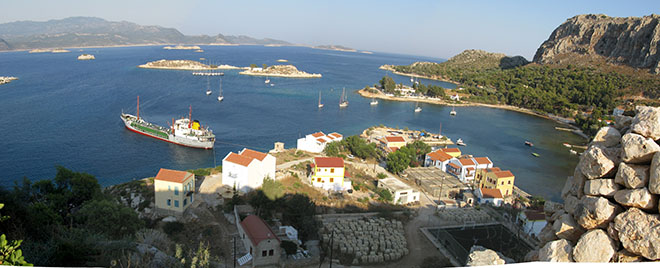
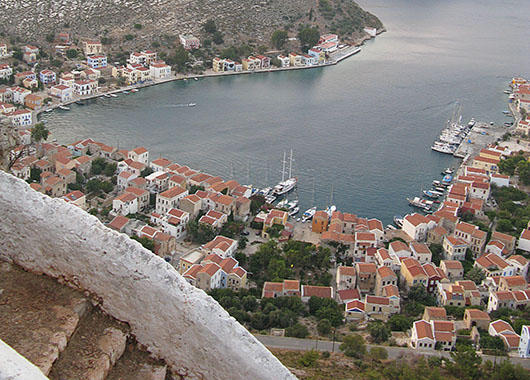
This beautiful blue and white house on the island was featured in the film Mediterraneo as Vasillisa's house. I wish they could make more films like that one!
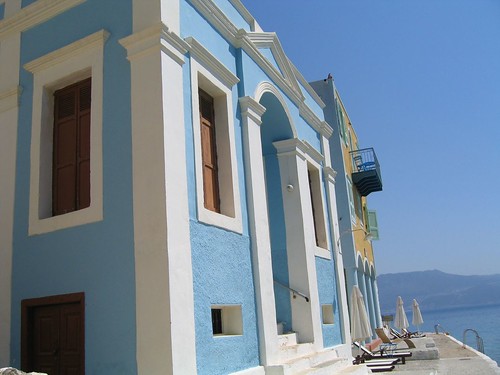


What a colourful island! An inspiration for an artist.

The traditional character of Kastellorizo along with its unspoilt beauty result into a landscape that can only make your heart beat. This house is a perfect example for this.
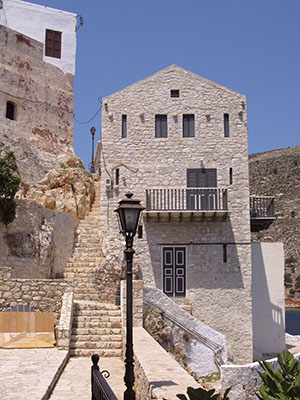
What else is there on the island? Well, two things.
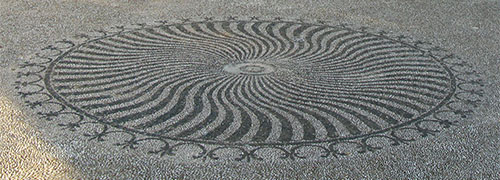
1. A spectacular pebble floor!
The mosaic floor of the "Avlogyro" square in the Horafia district of Kastellorizo is in excellent condition and features a roundel with a typical choklakia swirling radial design. Known as choklakia mosaics, they are made of black, white and sometimes reddish sea pebbles, and are to be found throughout the Dodecanese islands (for example Symi and Lindos on Rhodes). The mosaic tradition dates back to Byzantine times and motifs include abstract geometric forms as well as folkloric pictorial depictions.
2. Limestone!
As you can see in the "limestone beach" picture above, Kastellorizo island is rich with limestone. The island's geology is almost exclusively limestone. Due to the lack of significant flora covering the island, the landscape shows many features of karstification. There are a number of notable sea caves including the so called Blue Grotto which is much larger than its namesake in Capri.
The "limestone beach" picture is worth a million words, right?
 |
| Limestone beach - Kastellorizo |
Everything is so overwhelming about this island, about Greece in general. Actually "stumbling on" the mosaic floor and the "limestone beach" was the reason behind this post but the wealth of information on limestone made me decide I had to split the posts.
In the next post I will be "digging deeper" into limestone and talk about my own personal experience with mosaic making.
All images used in this post link back to their original source.
In the next post I will be "digging deeper" into limestone and talk about my own personal experience with mosaic making.
All images used in this post link back to their original source.
Like Mosaicology on Facebook
Saturday, December 10, 2011
Thank you
A short post to say THANK YOU to those that visit my blog and leave comments. You are all wonderful!
I am working on new posts that will appear on the blog mid next week unless I get more translation projects and need to postpone blogging for a couple days more. That is the reason why I am not blogging as I used to. I guess that hard work DOES PAY OFF after all!
I am sorry that I do not have the time to comment on your blogs ad I did before. But I do visit blogs often and I tweet stuff I like so PLEASE continue being inspiring!!!
Lots of love and a presto with new posts and if all goes all a little surprise...
M.
Monday, December 5, 2011
Bologna is getting festive


Dear All,
I know I have not posted in a while but I have good reasons :) I have been very busy with translation work, preparing a series of new posts for Mosaicology, organising the house, trying to figure out what's got to go for the new year etc etc.
You all know the drill.
So, I wanted first to post these pictures from Bologna centre that I took a few days back just to get into the spirit of Christmas and the Holidays.
A presto ! Later !
Subscribe to:
Posts (Atom)